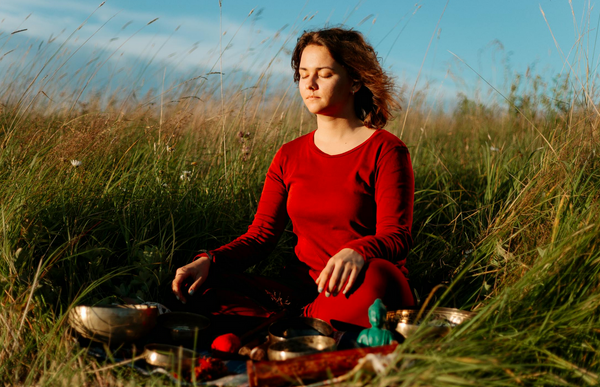
.
Imagine a practice that can help you dissolve anxiety quickly, easily, and safely[1]. Now imagine that same practice can regulate and balance the function of the cardiovascular, respiratory, immune, and endocrine systems of the body, leading to better "everyday" health[2J. Lastly, imagine that this practice isn't only effective -it's also pleasurable, and can help you to live a happier life. Your response might be to ask "how much does this "miracle cure" cost?" The answer is about 15 minutes a day, three or four times a week.
The "product" described above is meditation. It's been practised for thousands of years in one form or another, and is still popular today (according to some estimates - which should probably be taken with a pinch of salt - as many as half a billion[51 people meditate). Meditation can also be big business: mindfulness alone has been described as a "billion-dollar industry"[61. But this brings us on to the next important question: what exactly is meditation? The truth is that there is no simple answer, with different commentators using the term to cover anything from prayer to hypnosis to mindfulness to transcendental meditation. What we can do is note some commonalities between these disparate practices: first, they are all concerned with quieting the mind and controlling its focus. Second, they are all concerned with health or empowerment in some way, and to some degree. And third, meditation is egalitarian -it can be practised by anyone, regardless of social class, intellectual or physical ability, financial means, or moral standing.
That last point is important. Mindfulness might be a billion-dollar industry, but there's no reason anyone should have to pay to access its benefits. Meditation is so easy and so simple to learn that you don't need a teacher-you just need a few minutes and this article. Likewise, whatever limitations you feel you have, they are no barrier to meditation - just like physical exercise, everyone can gain some benefit from the practices described below… and often, the harder we find it when we begin, the greater those benefits are. But first, what's the science behind meditation?
The role of the parasympathetic nervous system
An important element in many meditations is the activation of the parasympathetic nervous system (PNS). One half of the autonomic nervous system, the PNS is functionally opposite to the sympathetic nervous system (which is concerned with the "fight or flight" response, and the release of stress chemicals like cortisol into the bloodstream). In contrast, the PNS is associated with relaxation, digestion, and regeneration.
Activating it results in a wide range of physiological effects, such as the regulation of your breathing, heart rate, and body temperature. In short, it maintains, regulates, and regenerates many of the body's everyday processes. Good health is created when the autonomic nervous system's two halves balance properly. But in our increasingly stressful world, that almost always means spending more time with your PNS activated, and less time with your sympathetic nervous system activated. PNS activation is a further commonality between different types of meditation. Actively slowing and deepening your breathing[81, focusing on the things you're grateful for rather than your everyday worries, and other common meditative techniques all stimulate the PNS. Given what we know about this powerful natural system, many of the benefits researchers have found from meditation are unsurprising:
Studies have shown that meditation decreases cardiovascular mortality rates, along with "hypertension, type 2 diabetes mellitus, dyslipidemia, and high cortisol levelsliij. It has been suggested that meditation can help resolve "many sex problems", including low libido in women and erectile dysfunction in men[121. Meditation has been shown to help asthma sufferers achieve "a significant improvement in quality of lifel131. It has been shown to be a "beneficial treatment" for irritable bowel syndrome (I BS){141. And a 2014 meta-analysis of 47 studies concluded that meditation could help improve anxiety, depression, and pain[i51.
Meditation for beginners: the Wuji Meditation
The meditation method described below is called the Wuji Meditation. It draws on practices from found in Tai Chi, Qi Gong, hypnosis, and tantra. But don't get hung up on names - there are hundreds of different ways to meditate, and many of them can activate the PNS. Ultimately, you will soon come to recognise when your PNS is activated, and you are free to proceed in whatever way suits you, once that's the case.
Preparation: What are you thankful for?
Wuji is the Taoist term for the "primordial universe" before Yin and Yang- it means "nothingness" or "emptiness". Consequently, as you may have guessed, a Wuji meditation involves entering a state called "Wuxin" (literally "mind without mind"), or "Mushin" in Japanese. But you can't (unless you are very gifted and highly experienced) simply "turn off" your everyday mind - the mind that makes shopping lists, worries about work, and prefers one TV show to another. To enter this state, you need to follow a process. And to follow this process, you need to do just a little bit of preparation.
It's very simple: make a list of ten things for which you are thankful, and memorise it. If you're very stressed, this might seem difficult at first. But it should be possible for everyone to complete this task. It may take a recalibration of attitudes, but we all have multiple things for which we should be thankful: that we're here at all, that it's a beautiful day, that we can laugh at a joke or look at a flower. This might sound a little contrived - and most of us are probably thankful for more personal things (family, the memory of favourite experiences, a particular piece of music). But we should be clear: gratefulness is a state of mind - a response to the external world, not the external world itself. That means all of us, however unlucky, can find plenty of things to be grateful for. So, once you have a list of ten things you can be grateful for, you need to really try to feel grateful for them. There's no getting around this - you're going to have to really think about these things, and for some of you, that might make you (temporarily) a little uncomfortable. Question what it is about these things that makes you feel grateful. It is not enough to say "my kids" - you need to explore why you are grateful for your children. Then ask why you don't spend more time thinking about these things, and how different life could have been if you didn't have them. Lastly, commit your list to memory.
Step One: From Mind to No-Mind…
Adopt a comfortable position. The simplest option (unless you're a Tai Chi or Yoga practitioner, in which case you will already know a number of meditation positions that suit you) is probably to sit up straight in a hard-backed chair, with hands palm down on your knees (which should be close together, but not necessarily touching). Lying down is fine too, provided you're not the type of person who will fall asleep and lose an hour of the day. Close your eyes, and concentrate on your breathing. You should focus on slowing and deepening your breath. Breathe in for a count of four, then hold the breath in for a count of four, then exhale for a count of five. This might be a struggle at first - don't let it stress you out. This pattern is a very common one to slow and regulate breathing, but if you really can't do it, start smaller. You can inhale for three, hold for three, then exhale for four. Or if a longer exhale is particularly troublesome, just use a three count for the inhale, the hold, and the exhale. Whatever count you are using, you should try to breathe more deeply than you are used to doing (unless, again, you are a Tai Chi or Yoga practitioner, in which case you'll already know your way around this kind of breath work). Your breath should enter through the nose and go all the way down to the pit of the stomach - imagine each in-breath filling up your torso like a barrel, from the bottom up. By the end of each inhalation, the air should have filled your lungs completely, all the way up to the top of the chest, just below the collarbones. This feeling of fullness should not be uncomfortable - don't try to overextend your lungs, just fill them. Then slowly exhale through the nose, deflating your lungs from the top down: collarbones, chest, stomach, pit of the stomach, until you are completely empty. The goal is to begin relaxing the mind and body, not achieve some special breathing target. Your ability to control your breathing, like your ability to meditate more generally, will increase overtime. So, don't stress about it - that's antithetical to the practice. Just do your best - it will be good enough, and it will get better with time.
Sitting comfortably, with slowed breathing, you should now focus on your list of ten things you're grateful for. Count backwards from ten to one, spending a few moments contemplating each item on the list before moving on. Try not to let your mind wander from your list - if you lose focus, just pick up from the point you last remember.
Thanks for reading!